
Project Summary
As the UX Lead for the Habits for a Better World I led a cross-functional team of designers to address the barriers preventing people from cultivating native plants. Our goal was to simplify the adoption process, raise awareness about the ecological significance of these plants, and ultimately support local biodiversity. In my role, I focused on ensuring that our solutions were not only user-centered but also could be used as tools to drive both environmental and community engagement outcomes.
Team: Nikunj Kanai, Noah Ratzen, Vera Schulz
Key Outcomes
- Uncovered pain points and user segments, guiding design direction.
- Proposed educational campaigns and community engagement strategies.
- Project Timeline
- Problem
- Research Approach
- Decision-Making
- Research Outcome:
- Our 5 Minute Presentation
- Next Steps
- Stay Tuned for Updates!
- Citations
Project Timeline
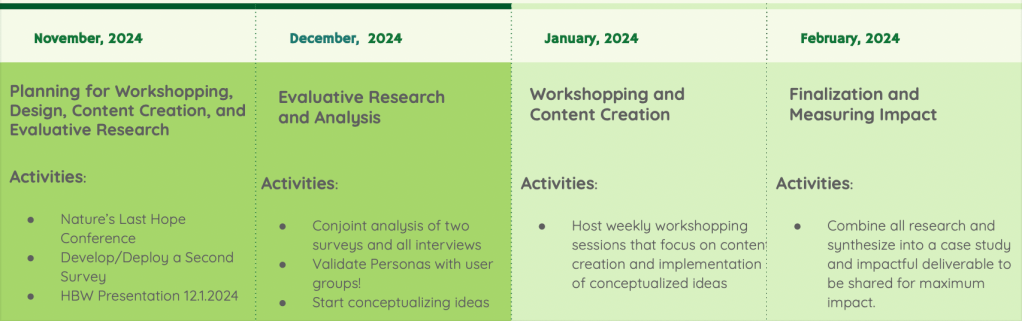
- November 2024: Planning, research, and survey distribution.
- December 2024: Data analysis, interview synthesis, and prototype development.
- January 2025: Refinement of chatbot and educational tools.
- February 2025: Final deliverables, case study preparation, and presentation.
Problem
Adopting native plants faces several barriers: low awareness of their ecological benefits, a cultural preference for non-native plants, concerns about maintenance, and safety issues for families with children and pets. These factors hinder widespread adoption, limiting potential contributions to local biodiversity.
Research Approach
To design a solution that would resonate across different cultures, our team utilized both quantitative and qualitative methods. Each approach provided a unique insight into user behaviors and needs, ensuring that our strategies were contextually relevant and impactful.
Why This Approach?
To design a solution that would resonate across different cultures, I utilized both quantitative and qualitative methods. Each approach provided a unique insight into user behaviors and needs, ensuring that our strategies were contextually relevant and impactful.
User Interview Guidelines
Our team conducted in-depth, one-on-one interviews to further explore user concerns and barriers to adoption. This process helped refine our understanding of the cultural and personal factors influencing plant choices, particularly the need for clearer, visually appealing information.
Global Quantitative Surveys
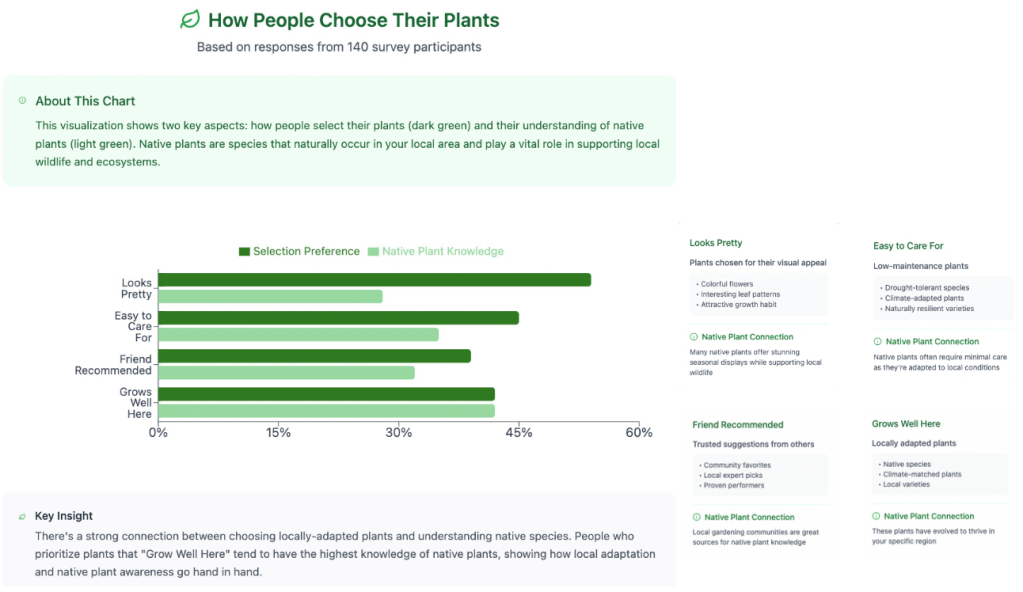
Our first survey revealed that 60% of participants were unaware of the ecological benefits of native plants. Many participants expressed a preference for non-native plants due to their aesthetic appeal and perceived ease of maintenance. These findings underscored the importance of addressing both awareness and visual preferences.
Local Qualitative Interviews (India, Sweden, USA)
Conversations with gardeners and environmentalists from diverse regions exposed cultural biases toward non-native plants. While there was interest in adopting native plants, users sought more practical, visually appealing information. By gathering insights from various cultural contexts, I ensured our approach remained sensitive to local gardening practices while promoting the ecological significance of native species.
Decision-Making
Educational Campaigns
The awareness gap was our top priority. However, I was mindful not to overwhelm users with scientific jargon. I advocated for using simple, accessible language to communicate the long-term ecological benefits of native plants while avoiding cognitive overload. This approach ensured that the information was digestible and motivating without losing its educational value.
Community Engagement
Local support was essential for fostering widespread adoption. I recommended partnering with gardening clubs and environmental organizations to create grassroots momentum. This decentralized approach ensured that our efforts felt personally relevant to users and allowed for community-based engagement and support.
Aesthetic Redesign
Understanding that visual appeal played a significant role in adoption, I worked closely with the design team to create native plant options that would appeal to a broader audience. By presenting native plants within familiar, curated garden designs, we avoided the “wild” or “untamed” connotations often associated with these species, making them more accessible and appealing.
Safety Information
A major concern for many users was the safety of native plants for families with children or pets. I ensured that we provided clear, easy-to-understand safety guidelines about which plants were safe for homes with young children and animals. This decision helped make the idea of planting native species feel safer and more practical.
Research Outcome:
The research recommended to focus on these key factors:
- Create educational campaigns designed with accessible, user-friendly language.
- Support community engagement by participating in local gardening clubs & volunteer efforts.
- In terms of plant descriptions – do an aesthetic redesign of native plant representations to align with common aesthetic preferences.
- Share safety and information Guidelines about native plants clarifying the safety of native plants for families.
Impact: The project not only raised awareness about native plant gardening but also simplified the process, making it more accessible. By aligning our strategies with user needs, ecological goals, and cultural contexts, we promoted a shift towards more sustainable, biodiverse gardening practices. This demonstrated my ability to lead with nuance, balancing ecological impact with user-centered design and fostering long-term behavior change.
Our 5 Minute Presentation
Next Steps
The next phase involves leveraging Generative AI to design an engaging interaction or chatbot that can disseminate information about native plants, further raising awareness and promoting adoption.
- Drawing Inspiration from:
This will be evaluated through a qualitative workshop with members of the community to ensure its relevance and effectiveness.
Stay Tuned for Updates!
Citations
- Scher, S., & Kapelari, J. (2019). Designing for Sustainability: A Practical Guide for UX Designers. O’Reilly Media.
- Altman, M., & Lyles, D. (2018). Native Plants and Sustainable Gardens: A UX Approach to Ecological Design. Springer.
- Ching, F. D. K., & Wang, C. Y. (2020). Sustainable User-Centered Design for Environmental Impact. Wiley.
- Gough, M. (2019). UX for Sustainability: Designing Products with Ecological Impact in Mind. Elsevier.
- Riche, Y., & Karr, J. (2018). Green Design: Integrating Ecological Principles into User Experience Design. CRC Press.
 Vera J. Schulz